What Is MDR? Meaning, Charges and Latest UPI Rules
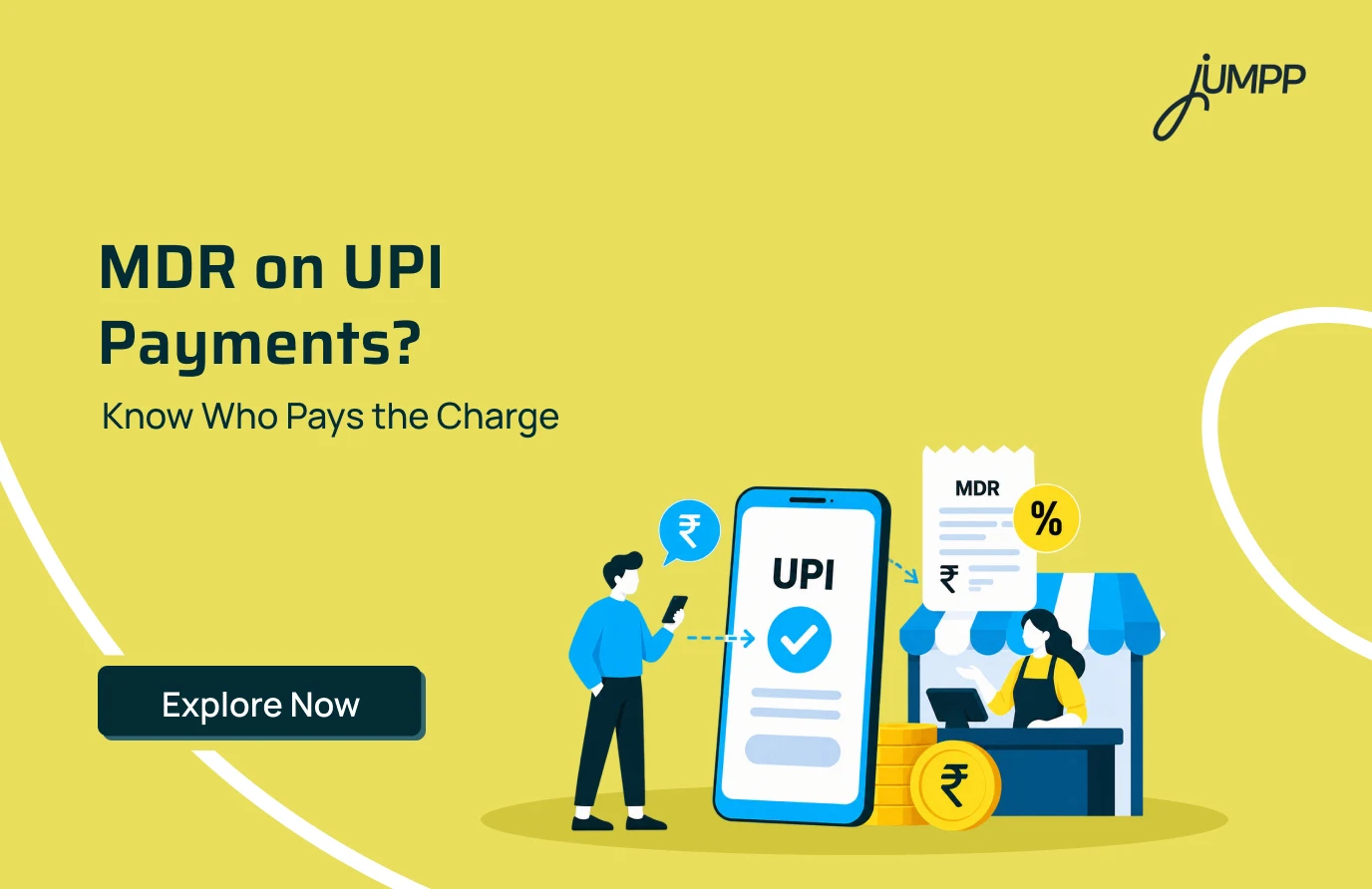
“UPI payments above ₹2,000 will now cost extra.”
That’s the worry doing the rounds after the latest MDR update. But before you start splitting your UPI payments, here’s the important part: customers are not being charged MDR.
The new rules apply to certain merchant payments, while customers continue to pay only the actual transaction amount.
So, what exactly has changed, who pays the MDR, and when does it apply?
Let’s break it down.
What Is MDR in a Payment Gateway?
MDR stands for Merchant Discount Rate. It is a fee that businesses or merchants pay for accepting and processing certain digital payments made by customers.
For example, when a customer pays a merchant digitally, banks, payment networks and other payment providers may be involved in processing the transaction. Where MDR applies, the merchant bears the applicable processing charge.
How Does MDR Work?
A digital payment passes through multiple participants before it is completed.
Here is how MDR works:
- Customer makes a payment: The customer pays through UPI, debit card, credit card or another supported method.
- Transaction gets processed: The payment moves through the relevant banks, payment network and payment service providers.
- Payment is settled: The transaction amount is processed for settlement to the merchant.
- MDR is applied: Where applicable, the processing charge is borne by the merchant.
The MDR collected can be distributed among different participants involved in processing the transaction.
These may include:
- Issuing Bank: The bank that issued the customer’s card or holds the paying account.
- Acquiring Bank or Payment Gateway: Helps the merchant accept and process digital payments.
- Payment Network: Facilitates communication and transaction processing between the participating entities.
The exact structure can differ depending on the payment method.
Do Customers Have to Pay Extra MDR Charges on UPI?
No. Customers do not have to pay MDR on UPI transactions.
Where applicable, the MDR is borne by the merchant. So, if your bill is ₹3,000, you continue to pay ₹3,000, not ₹3,000 plus MDR.
More than 95% of UPI merchant transactions are ₹2,000 or below and remain outside the new MDR charge.
Know UPI transaction limits in 2026!
What Are the Latest UPI MDR Charges in 2026?
Under the updated NPCI framework effective 15 October 2026, UPI MDR follows a tiered structure.
Here is a quick look at the key UPI MDR charges, thresholds and caps under the updated framework:
| UPI Transaction / Category | Transaction Limit | MDR Rate | Maximum MDR / Cap |
| Person-to-Person (P2P) | Any permitted amount | 0% | No MDR |
| Standard Merchant (P2M) | Up to ₹2,000 | 0% | No MDR |
| Standard Merchant (P2M) | Above ₹2,000 | 0.4% | Maximum ₹300 for transactions of ₹75,000 and above |
| Small Merchants (P2PM) | Up to ₹1 lakh in monthly UPI collections | 0% | No MDR |
| Railways, Telecom, Insurance, Fuel & specified categories | Above ₹2,000 | Flat ₹5 | ₹5 per transaction |
| Capital Markets – Mutual Funds, Securities, Stockbrokers & Dealers | Eligible UPI transactions | 0.02% of transaction value | Maximum ₹300 per transaction |
| UPI AutoPay / Mandates | Eligible recurring payments | 0% | No MDR |
Note: The Capital Market MDR applies to UPI payments towards Mutual Funds, Securities, Stockbrokers and Dealers. The MDR is 0.02% of the transaction value, capped at ₹300 per transaction.
- P2P (Person-to-Person): Private transfers sent between friends, family, or your own personal bank accounts.
- P2M (Person-to-Merchant): Commercial payments made to registered businesses, retail shops, or online e-commerce stores.
- P2PM (Small Merchant): Payments made to small-scale street vendors or local stalls using basic QR codes.
Standard P2M MDR: Quick Examples
| Transaction Amount | MDR | Merchant Pays |
| ₹2,000 | 0% | ₹0 |
| ₹3,000 | 0.4% | ₹12 |
| ₹50,000 | 0.4% | ₹200 |
| ₹75,000 and above | Capped | Maximum ₹300 |
For customers, the MDR remains ₹0. These rates and caps apply on the merchant side where applicable.
How are MDR Charges Calculated?
MDR may be calculated as a percentage of the transaction value. Depending on the payment category, a flat fee or maximum cap may also apply.
Suppose a ₹5,000 merchant transaction attracts an MDR of 0.4%.
MDR = ₹5,000 × 0.4% = ₹20
The applicable MDR would be ₹20.
However, there is no single MDR rate for every digital payment. The applicable charge can depend on the payment method, transaction amount, merchant category and prevailing rules.
Example of MDR on a High-Value UPI Payment
Suppose an eligible standard P2M transaction is ₹1,00,000. At 0.4%, the MDR would normally be ₹400. However, since the MDR is capped at ₹300 for transactions of ₹75,000 and above, the merchant pays ₹300 as MDR.
The customer still pays only ₹1,00,000.
Can Merchants Pass UPI MDR to Customers?
Under the referenced framework, merchants cannot add the applicable UPI MDR to the customer’s bill as a separate charge.
For example, if the bill amount is ₹2,500, the customer pays ₹2,500. An applicable MDR is handled separately on the merchant side.
UPI vs Debit Card vs Credit Card MDR
Here is a simple comparison of how MDR differs across common payment methods:
| Payment Method | Applicable MDR | Who Bears It? |
| UPI P2P | Zero | No MDR |
| UPI P2M up to ₹2,000 | Zero | No MDR |
| Standard UPI P2M above ₹2,000 | 0.4%, subject to applicable cap | Merchant |
| Debit Card | Subject to applicable RBI limits | Merchant |
| Credit Card | Commonly around 1.5%–3%, depending on arrangement | Merchant |
This is why MDR should not be understood as one fixed charge across all digital payments.
Watch Out for These Merchant Workarounds
While customers do not have to pay MDR, you may come across some situations while making UPI payments:
- Splitting the bill: A merchant may ask you to split a payment above ₹2,000 into smaller transactions to avoid the 0.4% MDR. For example, a ₹3,000 bill may be split into two ₹1,500 payments.
- RuPay Credit Card payments: The 0.4% MDR applies to standard bank-account UPI payments. RuPay Credit Cards linked to UPI follow separate card-related rules, so a merchant may ask you to switch to a bank-account UPI payment.
- Extra UPI charges: A UPI app does not automatically add an extra charge to your bill for high-value payments. The customer pays the actual bill amount.
- Changing the payment mode: A merchant may choose which payment methods to accept, but MDR should not be added separately to your UPI bill as an extra charge.
Conclusion
MDR is mainly a processing cost for merchants accepting certain digital payments. For customers, standard UPI payments continue without an additional MDR charge. Knowing the applicable rates, limits, and payment categories can help you understand what happens behind every digital payment.
FAQs
MDR in banking refers to the merchant-side processing cost associated with eligible digital payments made through banks and payment networks.
Under the updated 2026 framework, standard P2M UPI transactions above ₹2,000 attract 0.4% MDR, subject to the applicable cap. Different rates apply to specified essential services and capital-market transactions.
No. MDR is not a tax. It is a payment-processing charge associated with eligible merchant transactions.
No. MDR is a payment-processing charge, while GST is a tax. Applicable GST may be charged on the MDR or payment-processing service.
The merchant bears the applicable MDR charges, rather than the customer. For UPI, the updated framework also keeps MDR as a merchant-side charge. Customers continue to pay only the transaction amount.
There is no MDR-based monthly quota for individual users under the referenced framework. Standard transaction limits set by banks or UPI for security and risk management may still apply.
For small merchants with turnover up to ₹20 lakh, debit-card MDR is capped at 0.40%, with a maximum of ₹200 per transaction. For other merchants, it is capped at 0.90%, with a maximum of ₹1,000 per transaction. The applicable limit may also vary based on the payment acceptance infrastructure used.
Credit-card MDR commonly ranges from around 1.5% to 3% of the transaction value. The actual rate can vary depending on the merchant agreement, payment provider, card network, card type and transaction volume.
Yes. Under the referenced framework, P2M UPI transactions up to ₹2,000 carry zero MDR.