What Is a Zero Balance Account? Meaning, Benefits & RBI Rules
Most savings accounts in India require you to maintain an Average Monthly Balance (AMB). If your balance falls below the required amount, you may have to pay a penalty.
But what if you could access your entire savings without worrying about such charges?
A zero-balance savings account lets you do just that. But does this mean all banking services are free?
Let’s explore how these accounts work, their benefits, RBI rules and the key differences between zero balance and regular savings accounts
What Is a Zero Balance Account?
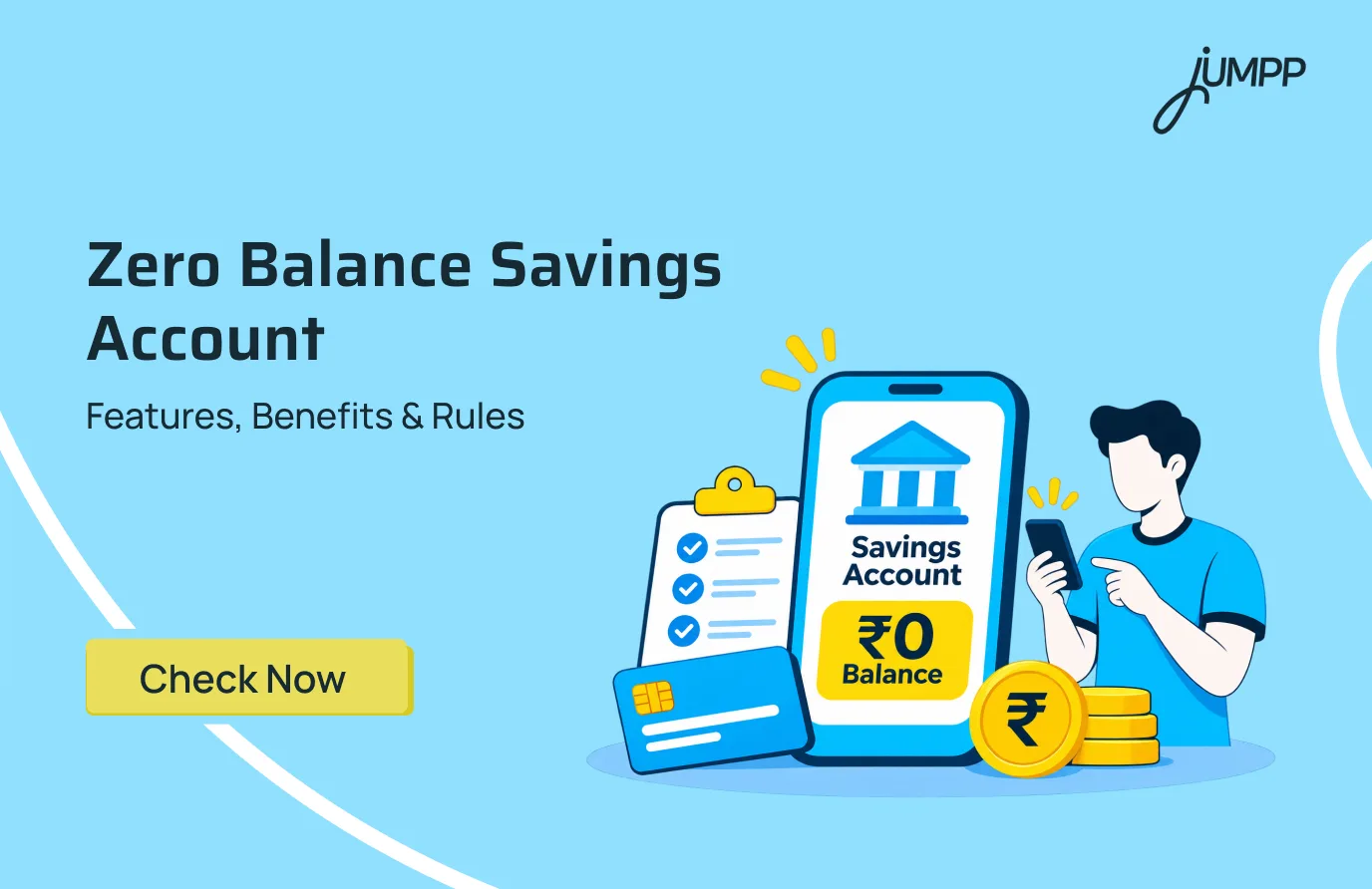
A zero balance account is a savings bank account that does not require you to maintain a fixed minimum balance.
For example, suppose you have ₹2,500 in your account and withdraw the entire amount. Your balance becomes ₹0, but you won’t be charged simply for not maintaining a minimum balance.
In India, zero-balance banking generally includes two types of accounts:
- Basic Savings Bank Deposit Account (BSBDA): A savings account category governed by RBI rules, with prescribed basic banking facilities.
- Other zero-minimum-balance savings accounts: Bank products that may offer zero-balance facilities permanently or for a limited promotional period.
How Does a Zero Balance Savings Account Work?
A zero balance account works like a savings account. You can deposit money, receive payments, withdraw funds and use supported banking services.
For example:
- You receive ₹10,000 in your account.
- You spend ₹6,000 on monthly expenses.
- You withdraw the remaining ₹4,000.
- Your account balance reaches ₹0 without a minimum balance penalty.
What Are the Features of a Zero Balance Savings Account?
A zero balance savings account provides essential banking facilities without charging you any penalty for a ₹0 balance.
- No Minimum Balance Requirement: You can keep ₹0 in your account without a minimum-balance penalty.
- Interest on Deposits: You earn interest on your savings at the bank’s applicable interest rate.
- Debit Card Facility: You have access to ATM withdrawals and card payments, subject to account conditions.
Related reading: What is the difference between a debit card and a credit card.
- UPI and Digital Banking: Make UPI payments, transfer funds and access mobile or internet banking where supported.
- Deposits and Withdrawals: Add or withdraw money according to the bank’s transaction rules.
- Direct Benefit Transfers: Receive eligible government benefits and other payments directly into your account.
What Are the Benefits of a Zero Balance Account?
A zero balance account offers absolute financial freedom by letting you utilise every rupee in the account without restrictions while still providing full access to digital banking services.
- Easy Start for First-Time Account Holders: Students and new earners can begin their banking journey without the pressure of maintaining a fixed balance.
- Suitable for Irregular Income: Freelancers and daily wage workers can manage fluctuating earnings without worrying about minimum balance requirements.
- Better Expense Organisation: You can easily keep daily spending separate from other savings to make budgeting and tracking easier.
Take control of your everyday finances with jAI, your AI-powered finance buddy.
Track expenses, create personalised budgets, set spending limits and get insights into your spending habits. Explore jUMPP, a budgeting app in India.
- Flexibility During Unexpected Expenses: Access your available money when urgent expenses arise without maintaining a compulsory balance.
Zero Balance Account vs Regular Savings Account
A Zero Balance Account gives you total liquidity to spend your balance down. On the other hand, a Regular Savings Account locks up a portion of your money as a mandatory minimum balance.
| Feature | Zero Balance Savings Account | Regular Savings Account |
| Minimum balance | ₹0 | May require a minimum balance |
| Non-maintenance penalty | None | May apply |
| Interest | Bank’s applicable savings rate | Bank’s applicable savings rate |
| ATM withdrawals | Subject to account conditions | Subject to account conditions |
| Debit card | Depends on account type | Generally available |
| Digital banking | Depends on the bank | Generally available |
| Other charges | May apply | May apply |
How to Open a Zero Balance Account Online Safely?
Many banks offer digital savings account opening.
Here’s how to get started.
Step 1: Compare account conditions
Check whether the minimum balance requirement is permanently waived or waived only for a limited period.
Step 2: Use an official banking channel
Visit the bank’s official website or verified app. Avoid unfamiliar links asking for banking credentials or OTPs.
Step 3: Complete the application
Enter your personal details and submit the documents requested by the bank.
Step 4: Verify your identity
Complete the applicable KYC process. Some banks provide Video KYC.
Step 5: Review the charges
Check the bank’s Schedule of Charges, including debit card fees, withdrawal conditions and optional services.
Step 6: Submit your application
Once verification is complete and the bank approves your request, your account can be activated.
Never share your banking PIN, password or OTP with someone claiming to help you open an account.
What Documents Are Required to Open a Zero Balance Account?
To open a zero balance savings account in India, you must complete the bank’s Know Your Customer (KYC) verification process.
Banks generally require the following documents for the zero-balance savings account opening process-
- Identity and Address Proof: An RBI-recognised Officially Valid Document (OVD), such as a passport, driving licence, voter ID, proof of possession of Aadhaar, NREGA job card or an eligible National Population Register letter.
- PAN or Form 60: Required as applicable under banking and tax rules.
- Photograph and Personal Details: As required for the account-opening process.
For online applications, banks may also require mobile OTP verification or Video KYC.
Open a Zero Balance Savings Account Through jUMPP
With jUMPP, eligible Indian residents can apply digitally for a YES Bank savings account with no minimum balance requirement for the first year, subject to the bank’s terms.
You’ll need PAN, Aadhaar and an Aadhaar-linked mobile number for this application journey.
Steps to Open Your Account
- Open jUMPP and tap Get Started in the Savings Account section.
- Enter your personal and professional details.
- Add your nominee’s name and relationship.
- Provide Aadhaar details, give consent and verify using OTP.
- Tap Do It Now to complete Video KYC.
Once YES Bank approves your application, you can start using the account.
To apply for a YES Bank savings account through jUMPP, keep your PAN, Aadhaar and Aadhaar-linked mobile number ready. You’ll also need to complete Video KYC.
FAQs on Zero Balance Savings Accounts
As per RBI rules effective from 1 April 2026, Basic Savings Bank Deposit Accounts (BSBDAs) do not require a minimum balance. They also offer prescribed free services, including a standard debit card, 25 cheque leaves per year and at least 4 withdrawals per month.
Yes, you can keep ₹0 in a zero-balance savings account without paying a minimum-balance penalty. However, regular savings accounts may have minimum balance requirements.
A Basic Savings Bank Deposit Account (BSBDA) has no minimum balance requirement under RBI rules. It provides essential banking services free of charge.
Individuals who meet the bank’s eligibility criteria and Know Your Customer (KYC) requirements can open a zero balance savings account. Minors may also be eligible, subject to the bank’s account-opening policies.
A zero balance account is suitable for basic banking without minimum-balance requirements, while a regular savings account may provide additional services and features. The choice depends on your banking needs, account benefits and applicable charges.