What Are Derivatives? Types, Uses and Examples
Imagine agreeing today to buy 100 shares of a company three months from now at today’s price, no matter what happens to the stock in between. You don’t own the shares yet, and you haven’t paid for them, but the price is locked in either way. That’s the basic idea behind a derivative in the stock market. A contract built around a share or index’s price.
What are Derivatives in the Stock Market?
Derivatives meaning in the stock market are instruments like stock and index futures and options, which derive their value from the price of the underlying share or index rather than requiring you to hold it directly. If you hold shares and worry about a price drop, buying a put option can help protect your position. Traders also use index futures to take a view on where the Nifty 50 or Bank Nifty is headed next.
How Do Derivatives Work?
At its core, a derivative works by tracking an underlying asset’s price through a contract that eventually gets settled or closed out.
- Underlying asset: The derivative’s value is tied to an asset, such as crude oil, a stock, or an index
- Contract terms: The contract fixes a price, quantity, and expiry date for the transaction
- Price movement: As the underlying asset’s price changes, the derivative’s value moves with it
- Expiry and settlement: At expiry, the contract is settled in cash or through delivery, or closed out earlier
- Leverage: Only a fraction of the total contract value is paid upfront as margin, amplifying both potential gains and losses
Example: If crude oil rises from $80 to $85 a barrel, a futures contract betting on that rise gains value in step with the price move, without the trader ever taking delivery of any oil.
What Are the Types of Derivatives?
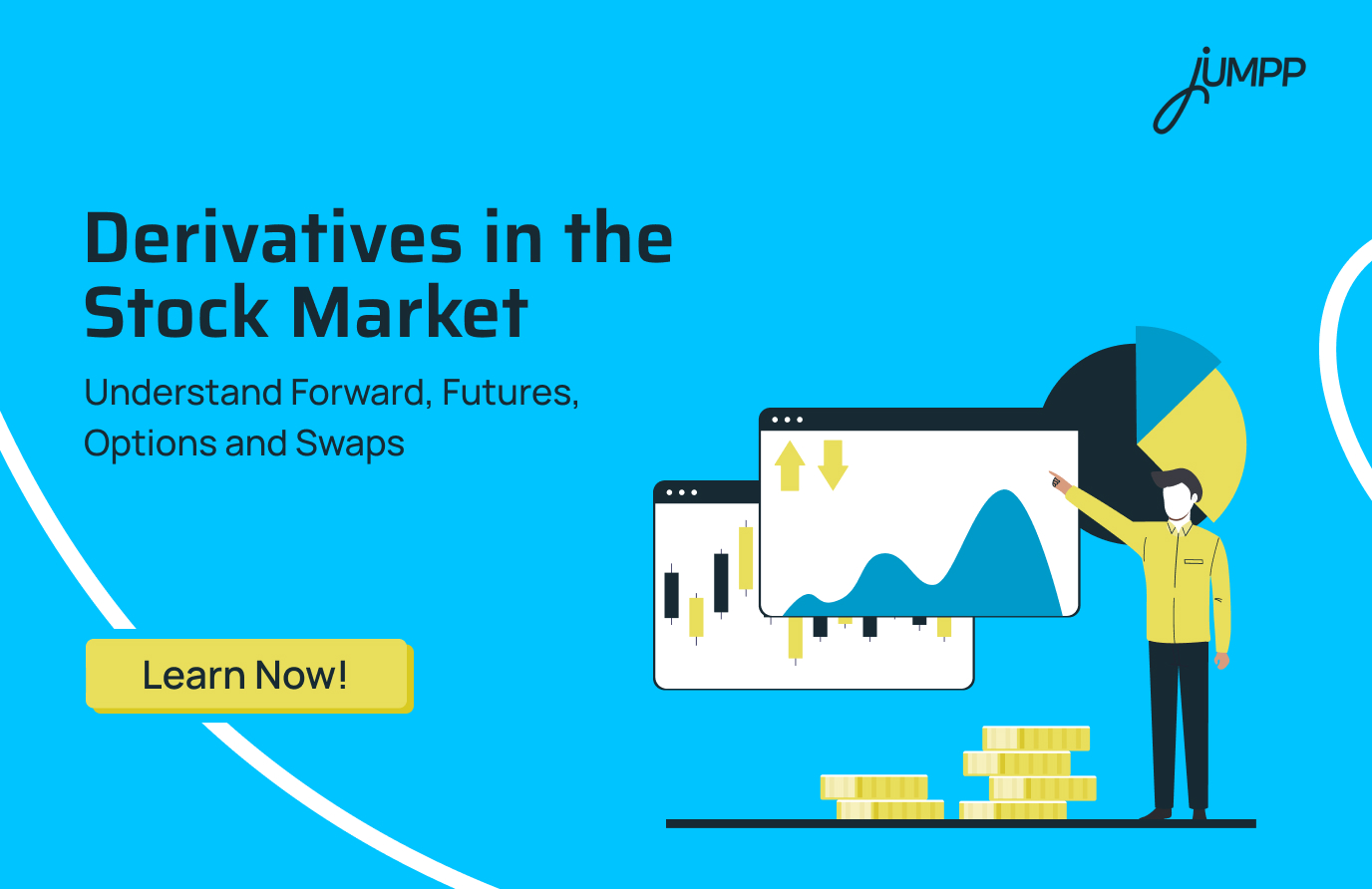
The four common types of financial derivatives are futures, options, forwards, and swaps, and not all of them work the same way or trade on the same platforms.
Futures Contract
A futures contract obligates both the buyer and seller to transact a specific asset at a predetermined price on a set future date. It’s standardised and traded on exchanges like the NSE. For example, an investor buying a Nifty futures contract is obligated to settle it at expiry, based on the index’s value at that time, unless the position is closed earlier.
Options Contract
An options contract gives the buyer the right, but not the obligation, to buy or sell an asset at a fixed price before a specified date. For example, an investor holding a call option on Reliance shares can choose to exercise it if the price rises above the fixed strike price, or let it lapse if it doesn’t, losing only the premium paid.
Forward Contract
A forward contract works like a futures contract but is negotiated privately between two parties rather than traded on an exchange. For example, an Indian exporter expecting a USD payment in three months might enter a currency forward with a bank to lock in today’s exchange rate, protecting against rupee fluctuations.
Swap Contract
A swap is an agreement where two parties exchange cash flows or financial obligations, commonly used to manage interest rate or currency exposure. For example, a company with a floating-rate loan might swap it for fixed-rate payments with a bank, to protect against rising interest rates.
| Derivative Type | Key Feature | Common Use |
| Futures | Standardised contract with an obligation to settle | Hedging or speculation |
| Options | Buyer has a right, but not an obligation, to exercise | Hedging or speculation |
| Forwards | Customised agreement between two parties | Managing future price or currency risk |
| Swaps | Agreement to exchange cash flows | Managing interest rate or currency exposure |
Note: Not every derivative trades on a stock exchange; forwards and swaps are typically over-the-counter agreements, and not every contract works the same way once you factor in obligation, customisation, and settlement.
Explore the difference between SGB vs Gold ETF to choose the best gold investment option in India.
What Is the Difference Between Futures and Options?
A futures buyer and seller must settle the contract, while an options buyer can simply choose not to exercise it if the trade doesn’t go their way.
| Factor | Futures | Options |
| Right vs Obligation | Both buyer and seller are obligated to transact | Buyer has the right, but not the obligation; the seller is obligated if exercised |
| Upfront Cost | Margin, a percentage of the contract’s total value | Premium, generally smaller than a futures margin |
| Maximum Loss for Buyer | Potentially unlimited, tied to price movement | Limited to the premium paid |
| Typical Use | Hedging or speculation with full exposure | Hedging or speculation with limited downside for the buyer |
What are Some Examples of Derivatives in India?
Here are some of the most commonly traded derivatives in Indian markets today.
- Index futures: Contracts on the Nifty 50 or Bank Nifty, used to take a view on the broader market
- Stock options: Contracts on individual shares, such as options on Reliance Industries or Tata Motors
- Currency forwards: Private agreements to lock in an exchange rate for INR against USD or other currencies
- Interest rate swaps: Used mainly by banks and large companies to manage exposure to interest rate changes
- Commodity futures: Contracts on gold, silver, or crude oil, traded on exchanges like MCX
What are the Uses of Derivatives?
Derivatives are generally used for one of three purposes: protecting a position, betting on a price move, or capturing a pricing gap.
- Hedging: Protecting an existing position from adverse price moves, such as an airline locking in fuel prices through futures to guard against rising costs
- Speculation: Taking a view on where an asset’s price is headed, such as buying index options ahead of an expected market move, without holding the asset itself
- Arbitrage: Profiting from small price differences for the same asset across different markets, such as a stock trading at slightly different prices on the NSE and BSE at the same moment
What Is the Derivatives Market in India?
The derivatives market is where these contracts are bought and sold, either on formal exchanges or through private, over-the-counter (OTC) arrangements.
| Factor | Exchange-Traded Derivatives | OTC Derivatives |
| Standardisation | Standardised contracts with fixed terms | Customised terms negotiated between two parties |
| Trading Platform | Traded on exchanges like NSE and BSE | Traded privately, outside an exchange |
| Counterparty Risk | Lower, since the exchange guarantees settlement | Higher, since it depends on the other party honouring the contract |
Exchange-traded derivatives like index futures and stock options are the most common route for retail investors, while OTC instruments like forwards and swaps are generally used by businesses and institutions managing specific currency or interest rate exposure.
How Can Beginners Trade Derivatives in India?
Getting started with derivatives trading follows a fairly standard sequence, regardless of which broker you use.
- Check account eligibility: You’ll need a trading account authorised for derivatives; a Demat account isn’t strictly required for cash-settled index derivatives, though it becomes necessary for stock derivatives carried to physical settlement, so check your broker’s specific requirements.
Start investing in Mutual Funds with the best investment app!
- Understand the contract: Know the lot size, expiry date, and settlement terms before entering any position
- Arrange margin funds: Derivative trading requires an upfront margin, a percentage of the total contract value, which your broker will specify
- Place your order: Select the contract, quantity, and order type through your broker’s trading platform
- Monitor and manage risk: Track your position regularly, since leverage can magnify losses quickly, and decide whether to square off before expiry or let the contract run its course
What Are the Advantages of Derivatives?
Used well, derivatives can offer benefits that go beyond simply betting on price direction.
- Hedging: Helps offset potential losses in an existing position, such as using a put option to protect against a stock price decline
- Capital efficiency: Lets you gain exposure to a larger position with comparatively less capital upfront, though this cuts both ways and increases risk alongside potential reward
- Speculation: Offers a way to take a view on an asset’s future price without owning it outright
- Price discovery: Derivative markets often reflect collective expectations, contributing to more transparent asset pricing
- Portfolio risk management: Can help manage overall portfolio exposure to specific sectors, currencies, or interest rate movements
What Are the Disadvantages and Risks of Derivatives?
The same features that make derivatives useful, leverage and flexibility, are also what make them risky.
- Leverage-related losses: The same leverage that can amplify gains can just as easily amplify losses, sometimes beyond your initial investment, particularly in futures
- Complexity: Many derivatives involve terms and structures that are genuinely difficult for beginners to fully understand
- Margin requirements and calls: If the market moves against your position, you may need to add funds quickly to maintain it
- Liquidity risk: Some contracts, especially less-traded ones, can be difficult to exit at a fair price when you need to
- Counterparty risk: Mainly relevant to OTC derivatives, where there’s no exchange guaranteeing the other party will honour the contract
- Time decay: Affects options specifically, an option’s time value erodes as expiry approaches, and how much this matters depends on whether you’re the buyer or seller of that option
Conclusion
Derivatives can be effective tools for managing risk or taking a market view, but the same leverage that creates opportunity also creates real risk, so they aren’t a fit for every investor or every portfolio. If you’re looking to build a broader investment foundation first, explore mutual fund investing before stepping into derivatives.
Derivatives in India- FAQs
A derivative is a financial contract whose value depends on another asset, such as a stock, gold, or currency. Traders use them either to profit from expected price moves or to protect against losses elsewhere in their portfolio.
The four main types are futures, options, forwards, and swaps. Each involves an agreement to buy, sell, or exchange something at a future date or under specific conditions.
Stock and index derivatives derive their value from the price of the underlying share or index. As that price moves, the value of the futures or options contract moves with it, based on the terms agreed in the contract.
Common examples in India include Nifty index futures, stock options on companies like Reliance, currency forwards for INR and USD, and interest rate swaps used by banks.
Futures obligate both parties to settle the contract, while options give the buyer the right, but not the obligation, to exercise it, capping the buyer’s maximum loss at the premium paid.