Digital Gold vs Gold ETF vs Gold Mutual Fund: Which Is Better?
Want to invest in gold without buying jewellery or storing coins at home?
Today, you can invest in gold through your phone, buy Gold ETFs on the stock exchange, or start a SIP in a Gold Mutual Fund.
But here’s the question: If all three are linked to gold prices, why choose one over another?
The difference lies in how they work, their costs, tax treatment and risks.
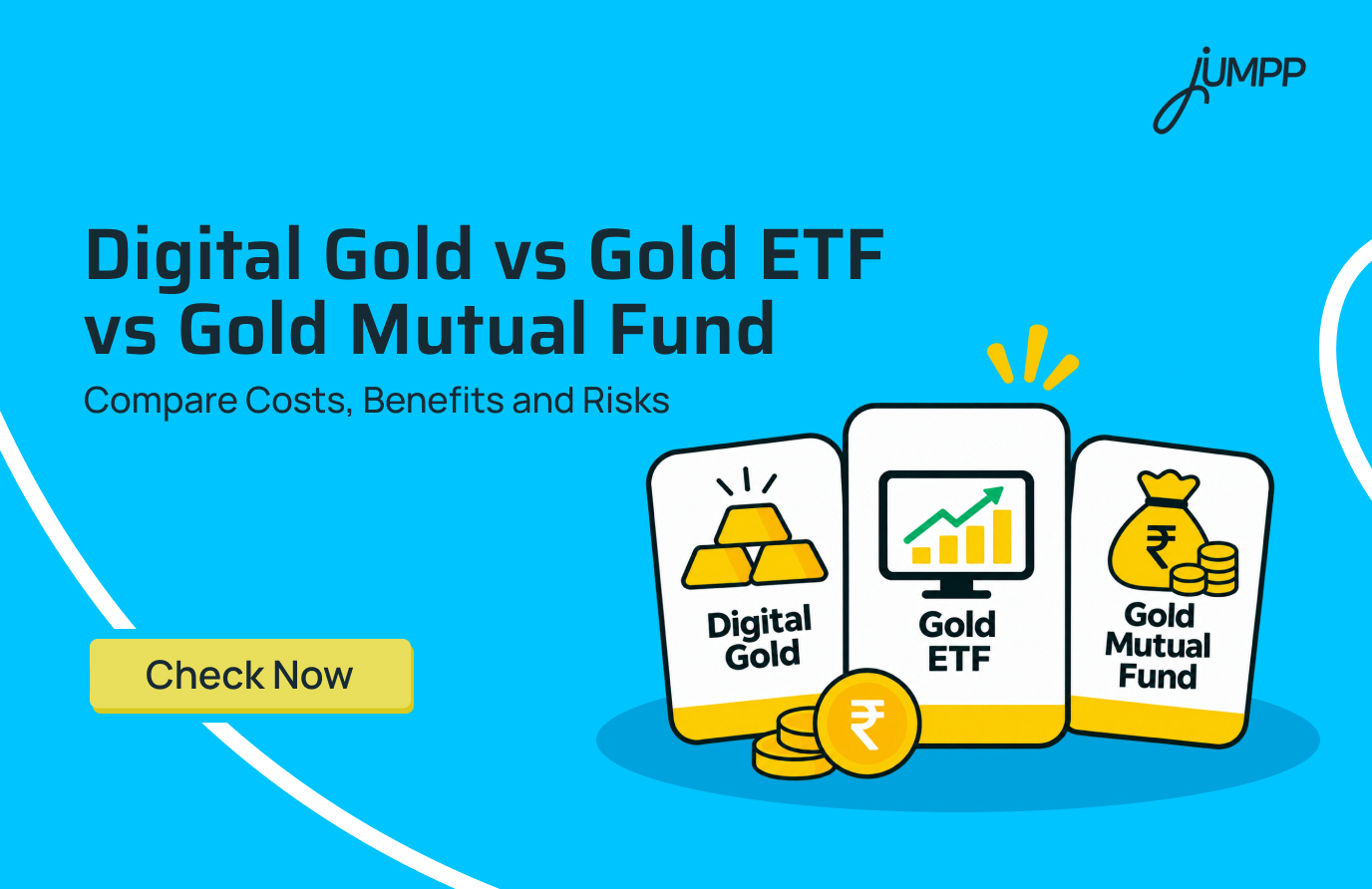
Let’s compare Digital Gold vs Gold ETF vs Gold Mutual Fund to understand which option may suit your investment needs.
What Are the Different Gold Investment Options in India?
Gold investment options in India include physical gold, Digital Gold, Gold ETFs, Gold Mutual Funds, Sovereign Gold Bonds and Electronic Gold Receipts.
Each offers a different investment structure, ownership arrangement and level of liquidity.
| Investment Option | How It Works |
| Physical Gold | Buy jewellery, coins or bars |
| Digital Gold | Purchase gold through an online provider |
| Gold ETF | Buy units of a gold-linked fund on a stock exchange |
| Gold Mutual Fund | Invest through a mutual fund scheme |
| Sovereign Gold Bonds | Hold government-issued gold-linked bonds, subject to availability |
| Electronic Gold Receipts | Trade eligible receipts backed by vaulted gold |
How Do Digital Gold, Gold ETFs and Gold Mutual Funds Work?
Digital Gold is purchased through an online provider, Gold ETFs trade on stock exchanges, and Gold Mutual Funds provide gold exposure through mutual fund schemes.
Let us consider an example of three beginner investors who each want to allocate ₹5,000 toward gold:
- Investor A purchases ₹5,000 worth of Digital Gold through an app. The corresponding gold is held under the provider’s storage arrangement.
- Investor B purchases Gold ETF units worth approximately ₹5,000 through a trading account.
- Investor C invests ₹5,000 in a Gold Mutual Fund and receives units based on the applicable NAV.
All three gain exposure to changes in gold prices, but their investment processes, charges and regulatory protections differ.
What Is Digital Gold?
Digital Gold is an investment product that lets you buy gold online in small quantities such as ₹1, with corresponding physical gold held through the provider’s storage arrangement.
What Are the Advantages and Disadvantages of Digital Gold?
Digital Gold allows you to buy gold online in small amounts without a Demat account and may offer physical redemption.
However, it is not SEBI-regulated and carries provider-related risks, buy-sell spreads and possible delivery charges.
| Advantages | Disadvantages |
| Small online purchases | Outside SEBI’s securities-market framework |
| No Demat account required | Provider and counterparty risks |
| Convenient app-based access | Buy-sell spreads can affect costs |
| Physical redemption may be offered | Delivery charges and conditions may apply |
What Is a Gold ETF?
A Gold ETF (Exchange-Traded Fund) is a SEBI-regulated mutual fund scheme that invests directly in physical gold bars of 99.5% purity.
What Are the Advantages and Disadvantages of Gold ETFs?
Gold ETFs offer SEBI-regulated gold exposure and exchange-based trading.
However, they require a Demat account and also involve fund expenses and trading charges.
| Advantages | Disadvantages |
| SEBI-regulated structure | Generally requires trading and Demat accounts |
| Exchange-based transactions | Brokerage and other charges may apply |
| No personal storage of physical gold | Market price may differ from NAV |
| Visible market prices | Liquidity varies across ETFs |
| Electronic ownership | Fund expenses and tracking differences affect returns |
What Is a Gold Mutual Fund?
A Gold Mutual Fund is a mutual fund scheme that provides exposure to gold, commonly by investing in Gold ETFs.
Unlike an ETF, it can generally be purchased through a mutual fund platform without a Demat account.
What Are the Advantages and Disadvantages of Gold Mutual Funds?
Gold Mutual Funds offer SEBI-regulated gold exposure and SIP options.
However, they may involve additional fund expenses, follow NAV-based pricing and do not allow intraday exchange trading.
| Advantages | Disadvantages |
| Generally available without a Demat account | Additional expense layer may apply |
| SIP facility commonly available | No intraday exchange trading |
| Accessible through mutual fund platforms | Transactions use applicable NAV |
| SEBI-regulated structure | Underlying fund expenses affect returns |
Digital Gold vs Gold ETF vs Gold Mutual Fund: What Are the Key Differences?
Gold ETFs and Gold Mutual Funds operate under SEBI’s mutual fund framework, while Digital Gold falls outside SEBI’s securities-market regulatory framework.
| Feature | Digital Gold | Gold ETF | Gold Mutual Fund |
| What is it? | Gold purchased online through a provider | Exchange-traded fund linked to gold prices | Mutual fund that generally invests in Gold ETFs |
| Demat account | Not required | Generally required | Generally not required |
| How to invest | Apps or digital platforms | Stockbroker or trading platform | Mutual fund platforms |
| SIP facility | Provider-dependent | Broker-dependent | Generally available |
| Regulation | Outside SEBI’s securities-market framework | SEBI-regulated | SEBI-regulated |
| Physical redemption | May be available, subject to conditions | Generally unavailable to retail investors | Generally unavailable |
| Main costs | GST, buy-sell spread and provider charges | Expense ratio, brokerage and transaction costs | Fund expenses, including underlying ETF costs |
Digital Gold vs Gold ETFs vs Gold Mutual Funds Taxation
The following table summarises the general framework for resident individual investors under the tax rules applicable in 2026.
| Tax factor | Digital Gold | Gold ETF | Gold Mutual Fund* |
| Long-term holding period | More than 24 months | More than 12 months | More than 24 months |
| Long-term capital gains tax | 12.5% | 12.5% | 12.5% |
| Short-term capital gains tax | Applicable income tax slab rate | Applicable income tax slab rate | Applicable income tax slab rate |
Which Gold Investment Option Should You Choose?
The best way to invest in gold depends on your budget, investment goals and how you prefer to manage your money.
You can choose Gold ETFs if:
- You already have a Demat account.
- You want to buy or sell during market hours.
- You prefer direct ETF exposure without an additional fund-of-funds expense layer.
You can choose Gold Mutual Funds if:
- You want to invest regularly through SIPs.
- You prefer a simple, hands-off investment process.
- You want to manage gold investments alongside other mutual funds.
You can choose Digital Gold if:
- You want to start with small amounts.
- You prefer occasional purchases through an app.
- You may want to convert your holdings into physical gold later, subject to provider terms.
Explore Gold Investment Options with jUMPP
Looking to start your gold investment journey?
With jUMPP, you can buy Digital Gold starting from ₹50 or explore 1,000+ direct mutual fund schemes.
Explore your options, review the applicable charges and invest conveniently with jUMPP, an investment app in India.
Start Investing.
FAQs
The choice between Digital Gold and Gold ETFs depends on your investment needs. Gold ETFs offer SEBI-regulated exposure to gold through stock exchanges. On the flip side, Digital Gold allows small online purchases without a Demat account. It is not SEBI-regulated.
Gold ETFs may suit investors who prefer buying and selling during market hours. Gold Mutual Funds may suit those who prefer SIP-based investing without a Demat account. Compare expenses and transaction costs before choosing.
Digital Gold allows small online purchases and may offer physical redemption. Gold Mutual Funds provide SEBI-regulated gold exposure, generally support SIPs and do not require a Demat account.
Gold ETFs offer regulated gold exposure, exchange-based transactions, electronic ownership and access to market prices during trading hours.
No. SEBI has clarified that Digital Gold products offered through online platforms fall outside its securities-market regulatory framework.